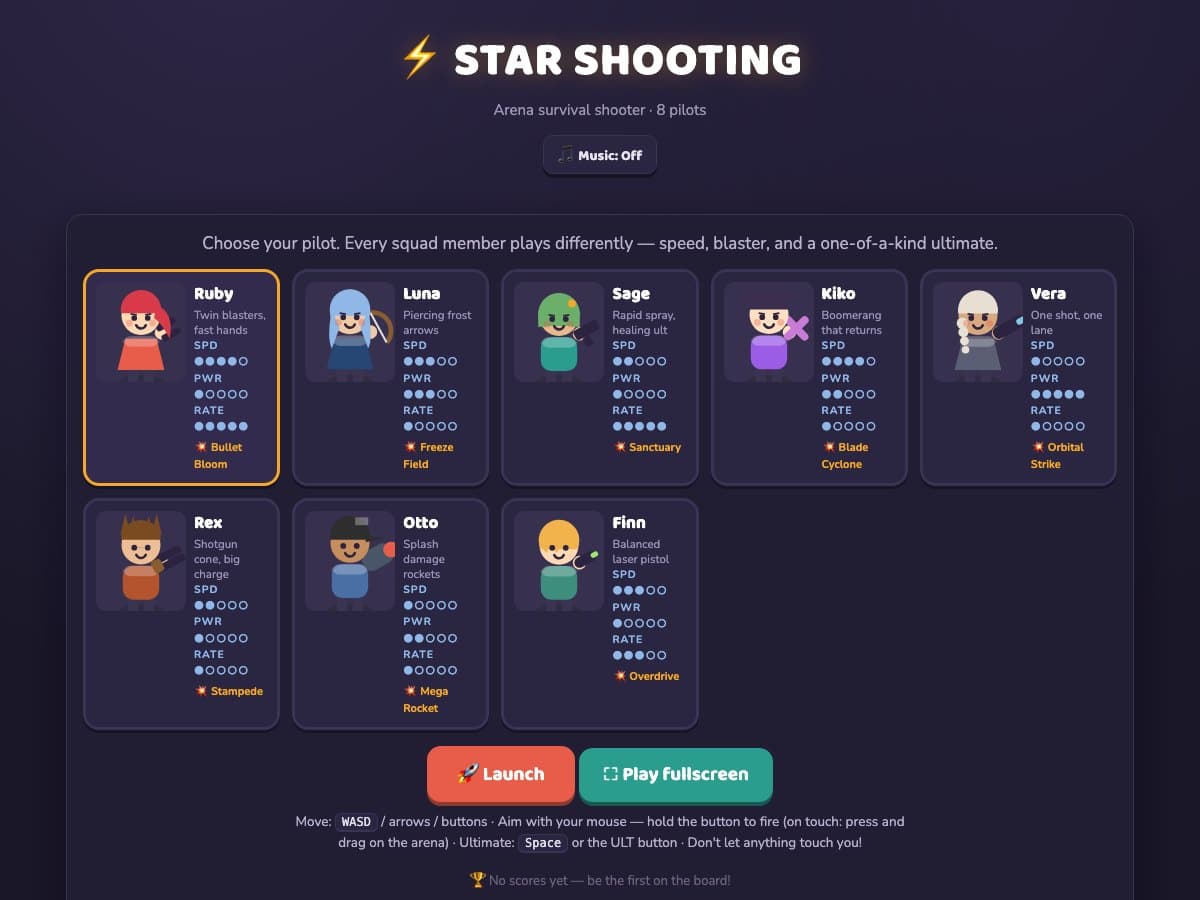
Star Shooting
An arena survival shooter: pick one of eight pilots and hold out as the waves get meaner.
View project →Come up with an original game idea and guide AI to build it, then iterate until it's actually fun to play.
Students learn to come up with a game idea, guide AI to implement characters, levels, and mechanics, and iterate through playtesting until the game is fun. By the end, each student has a playable game they built themselves.
Students who love games and want to design and build their own, using AI to implement their ideas while they stay in charge of the design and iteration.
Included with enrollment. Contact us for more info.
Where students start, and what they can do by the end. Every student moves through these at their own pace with mentor guidance.
‘A game where you fight dragons’ becomes a core loop the student can describe: what the player does, what makes it hard, and what makes it worth doing again.
Characters, levels, and mechanics come together until there is something another person can actually pick up and play, however rough it looks.
Other people play it while the student watches. They learn to tell the difference between what they hoped would be fun and what actually is, then cut what is not working, including ideas they were attached to.
The student ends with a playable game they designed and built, and can say why each part of it ended up the way it did.
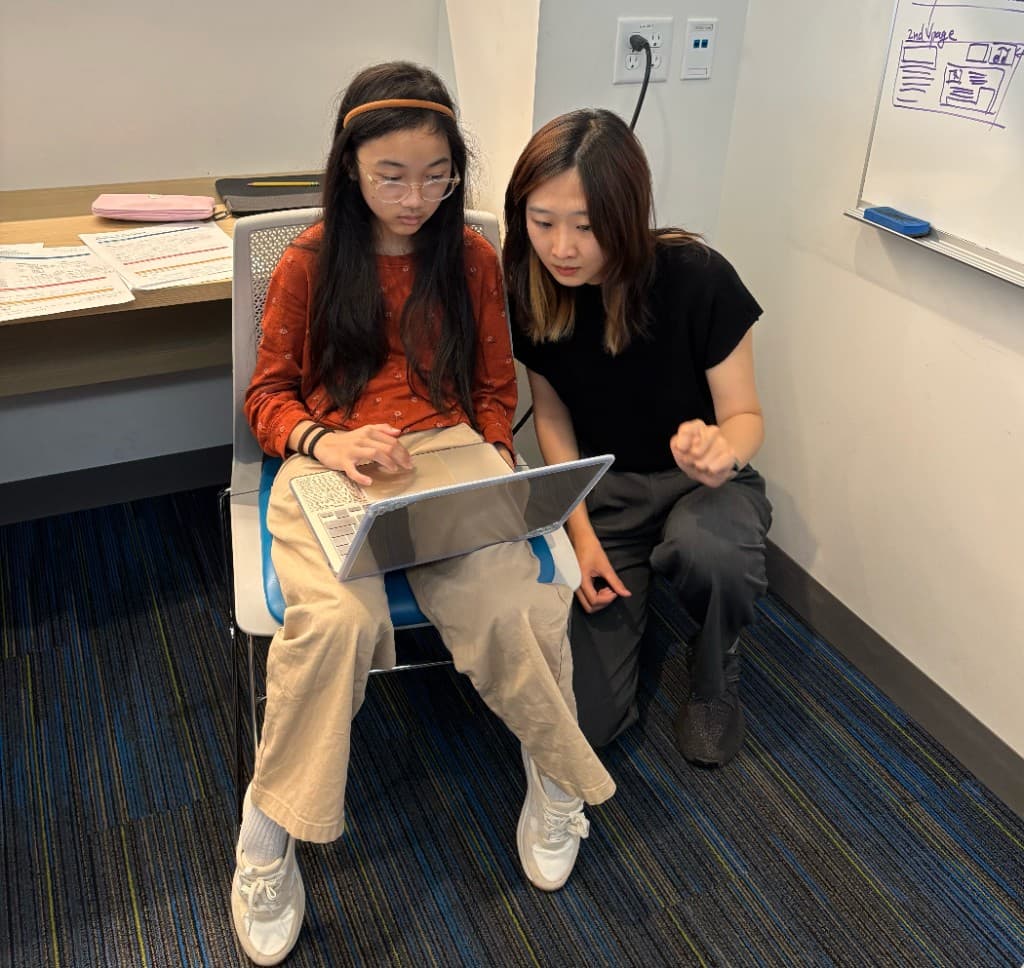
Moments from live sessions: small groups, mentors, and hands-on work.
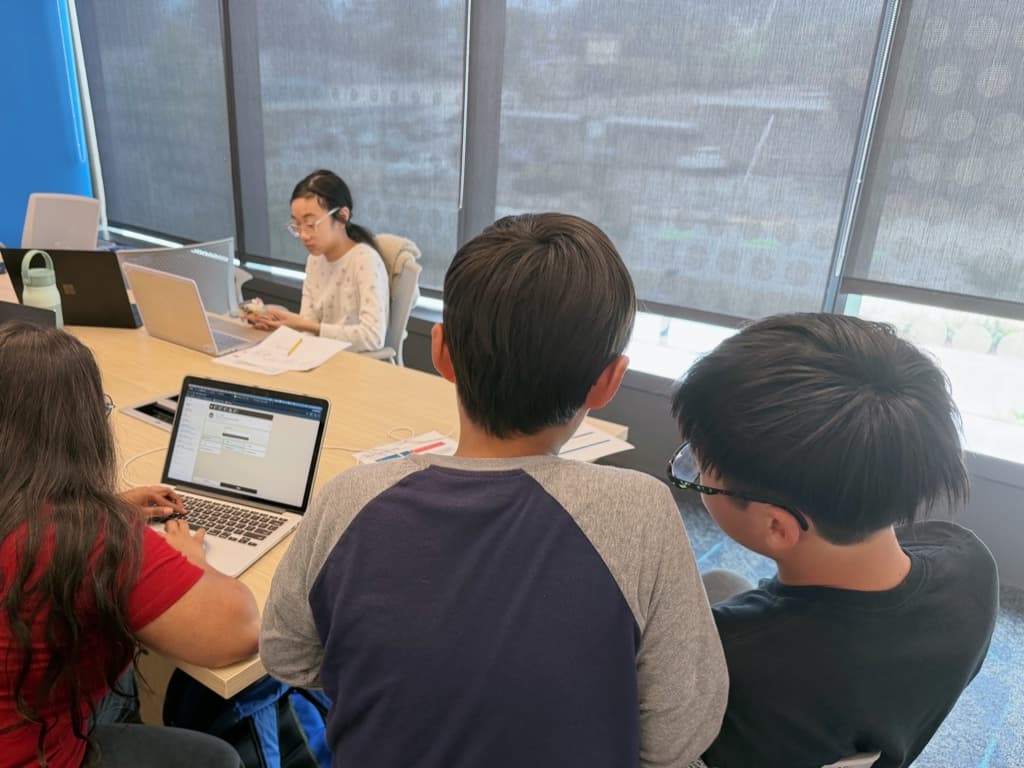
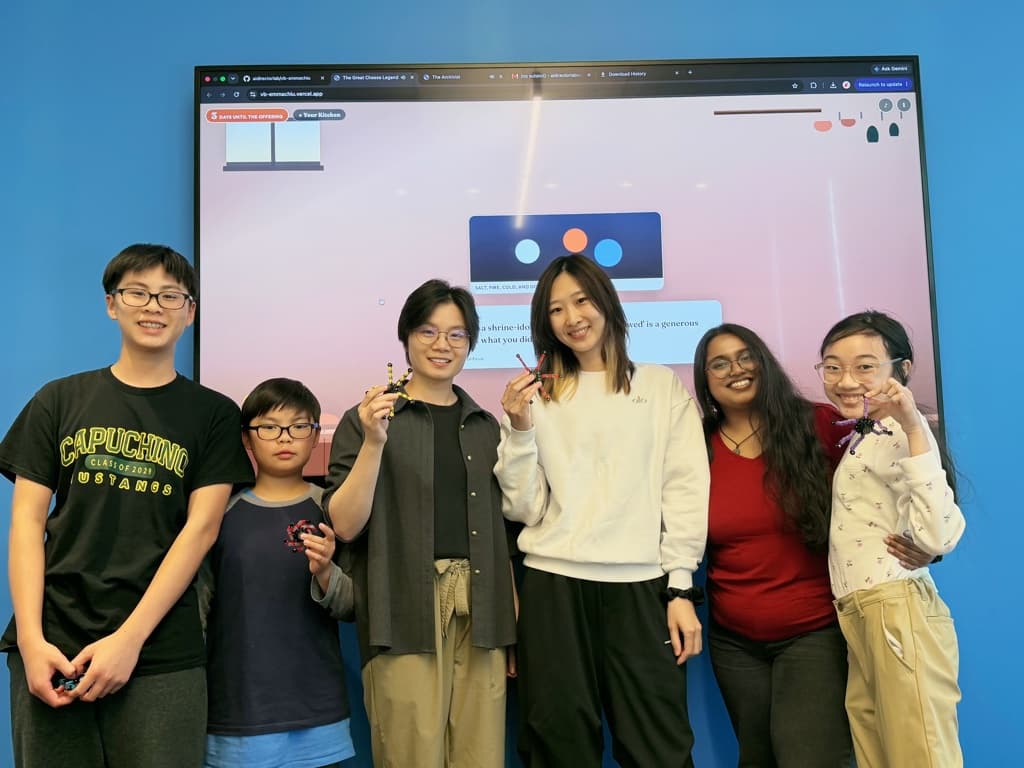
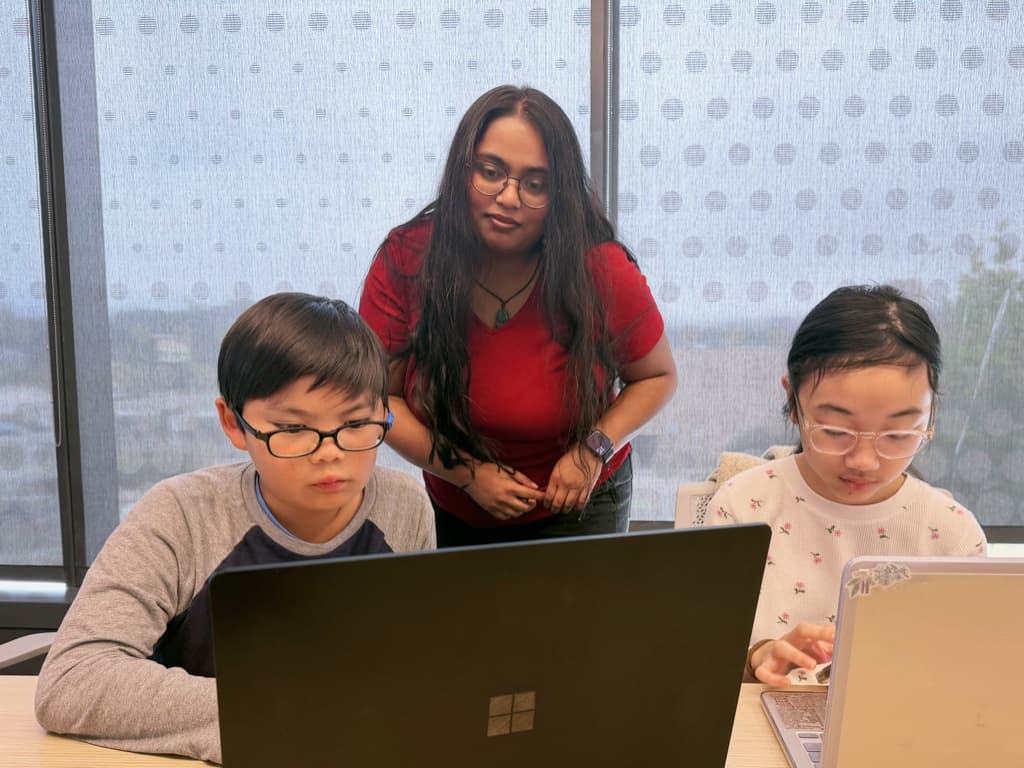
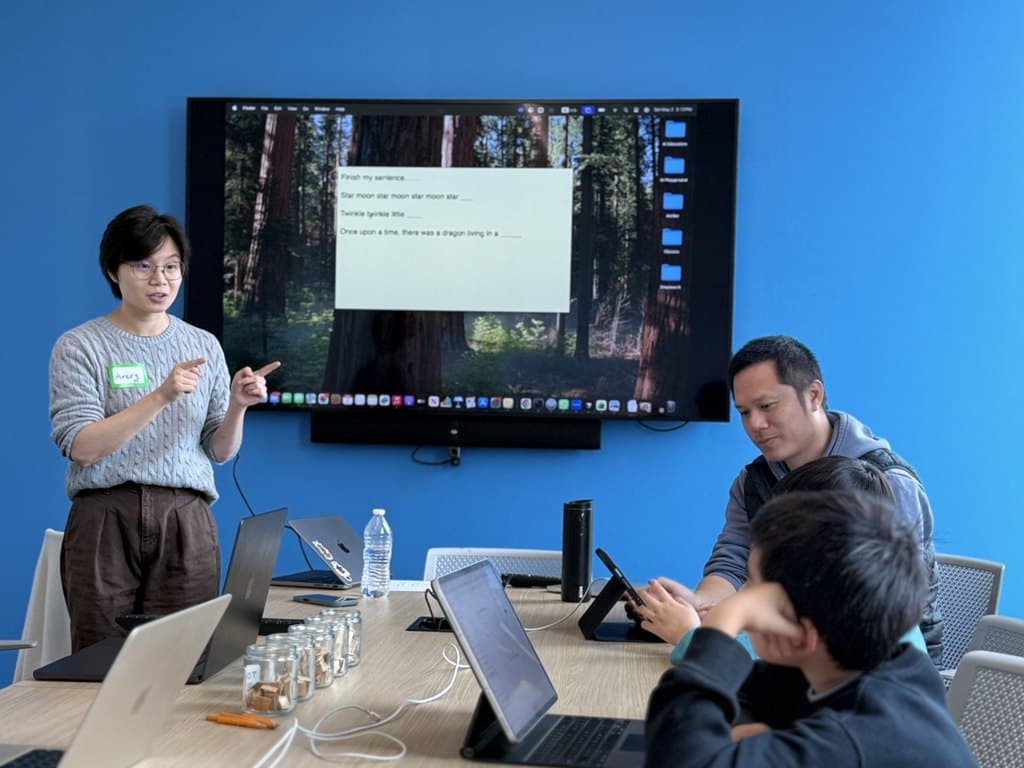
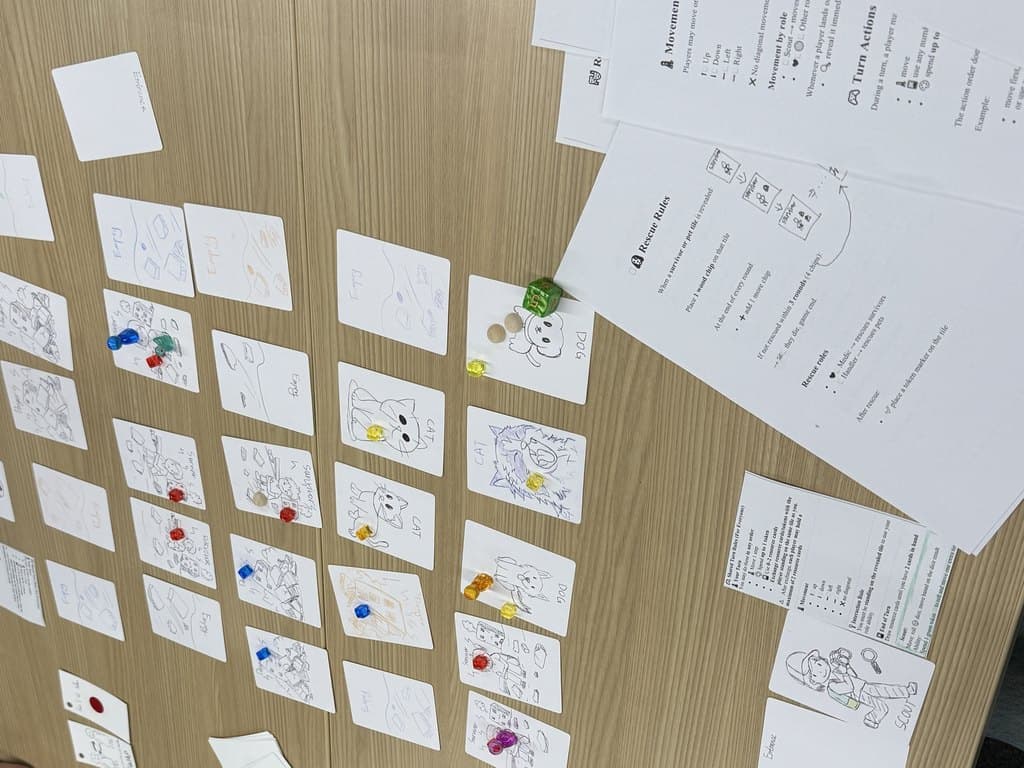
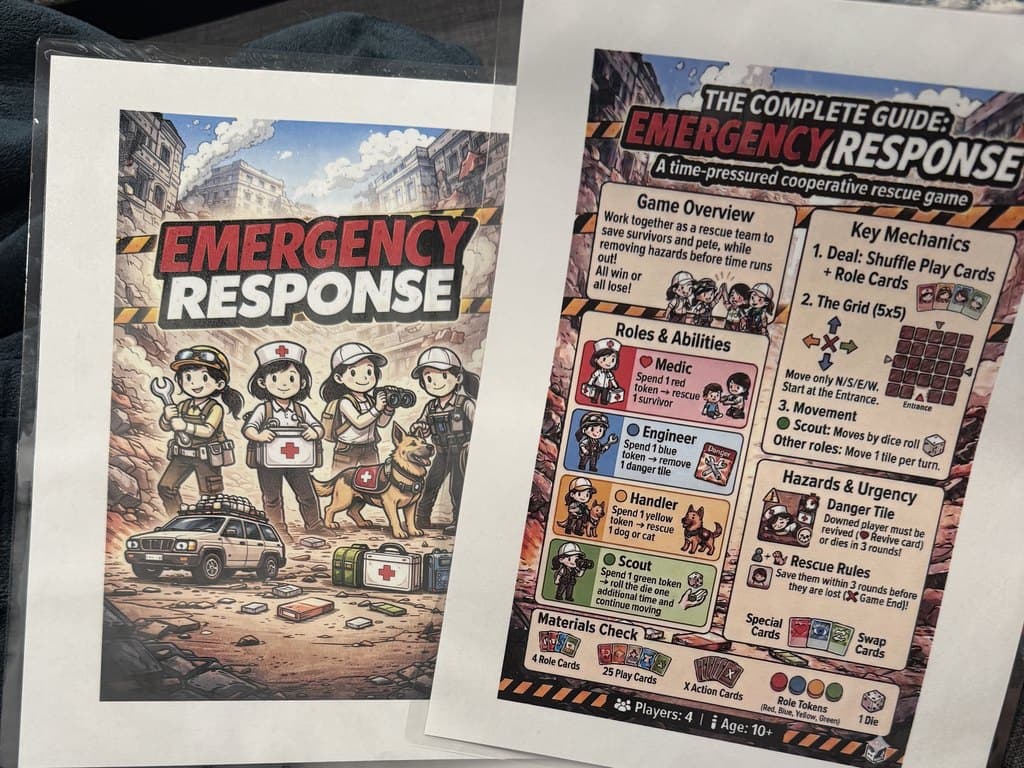
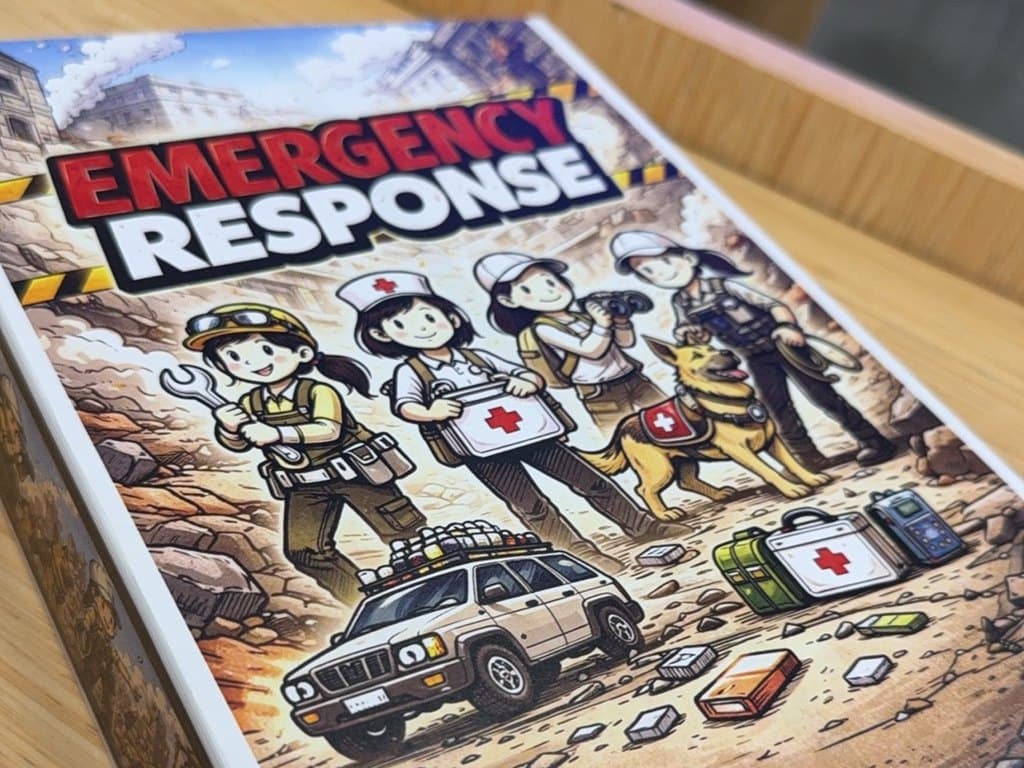
Game concepts and prototypes students design and share.
An arena survival shooter: pick one of eight pilots and hold out as the waves get meaner.
View project →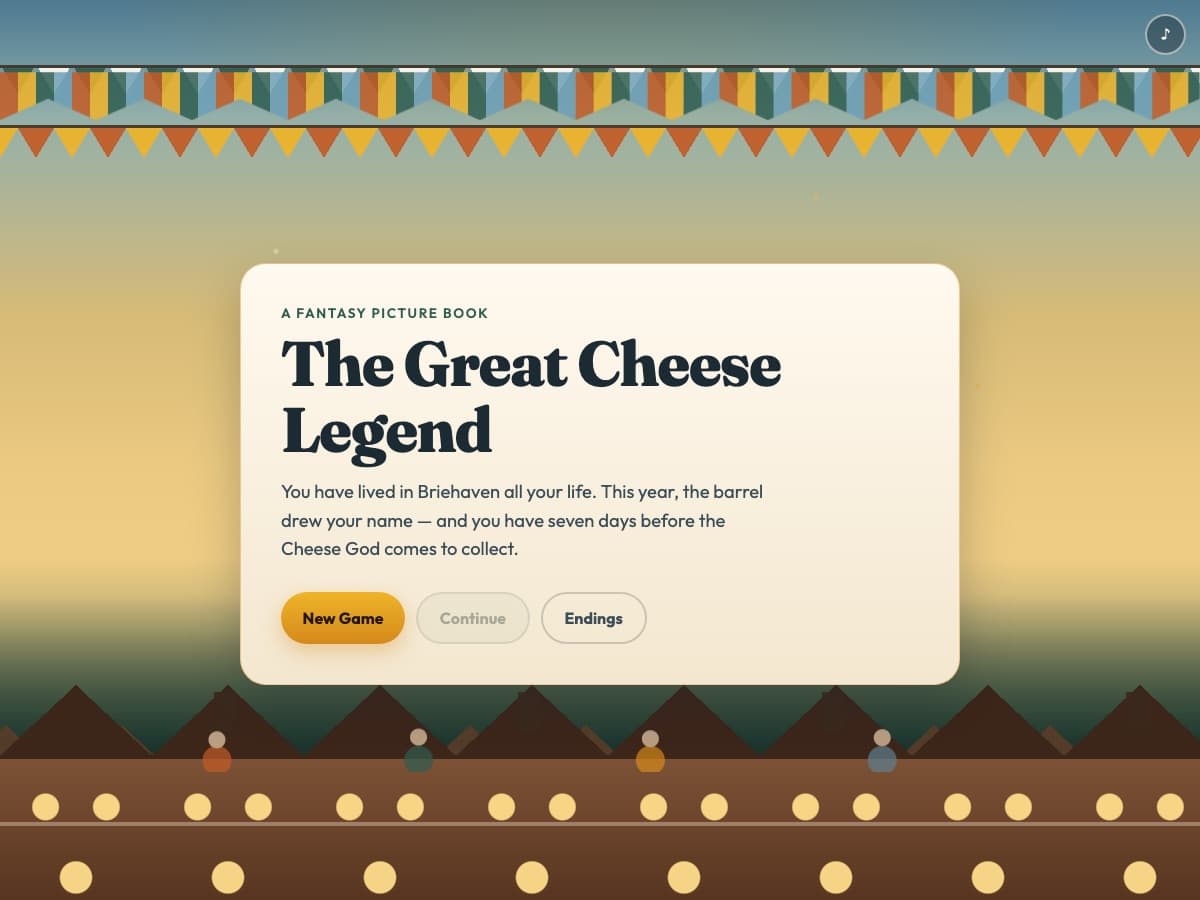
Game Design is taught with real design practice in mind. One co-founder formally studied game design at Stanford; both bring build, playtest, and cut experience from industry.
for the full 12-hour course
Available to the first 8 students who enroll.
ApplyThe questions families ask us most. If yours is not here, email us.
A playable game they designed and built, that other people can actually play. Previous students have finished playable games including Star Shooting and The Great Cheese Legend.
Real game design. One of our co-founders formally studied game design at Stanford, and students work with the concepts a university course covers: core loops, game feel, difficulty curves, player motivation, and playtesting methodology, applied to a game they build themselves. AI helps implement it; the design thinking is the actual subject.
No. Students arrive with a game they want to exist. The course teaches them how to get it built and how to judge whether it is any good.
The student owns the design and the iteration, which is where games are actually won or lost. AI helps implement art, logic, and mechanics; deciding what the game should be and what to change after a playtest is the student’s job.
That is the course, not a failure in it. Almost no first version is fun. Students playtest, watch real players, and iterate. Learning to cut what does not work is one of the main things they take away.
Ages 8 to 18. The group is small enough that students work at their own level of ambition.
12 hours across three weekends. It is the longest of our courses because playtesting and iteration need time between sessions.
Tuition is $100 per instruction hour, so Game Design’s 12 hours come to $1,200. The code DIRECT30 takes 30% off for the first 8 students who enroll, bringing it to $840.
Closely, and by design. Students write their own design down before they are allowed to go to AI at all. Mentors watch how each student works and step in when someone starts accepting output instead of judging it. The habit we want them to leave with is: always think first.
Capped at 10. Small groups also mean students playtest each other’s games, which is where the most useful feedback comes from.
A laptop. Students build on their own computer so the game and the project files go home with them.
The mainstream tools professionals use, such as ChatGPT and Claude, alongside AI tools for art and development. The specific mix changes as the tools change, because the skill we teach is directing AI, not memorising one product’s interface.
In person in the Bay Area, currently South San Francisco or Stanford. We pick the venue once the group forms so the drive works for the families who actually enrolled. With three weekends of sessions, that choice matters more here than on our shorter courses.
Once a group fills. This course spans three weekends, so we confirm the full run of dates with enrolled families before locking it in. Applying early also gives you more say in the schedule.
One of our co-founders formally studied game design at Stanford, so the design concepts in this course are taught properly rather than improvised. Both co-founders also build real systems for a living: Head of Data at Taskrabbit, data and AI teams at Asana, Twitter, and Glassdoor, and production software at Arista Networks. Both co-founders teach every Game Design cohort themselves.
Game Design has its own application form, and you enter the promotion code when you apply. Because this course runs across three weekends rather than two, check the dates work for your family before you commit.
Apply using this course's application form.